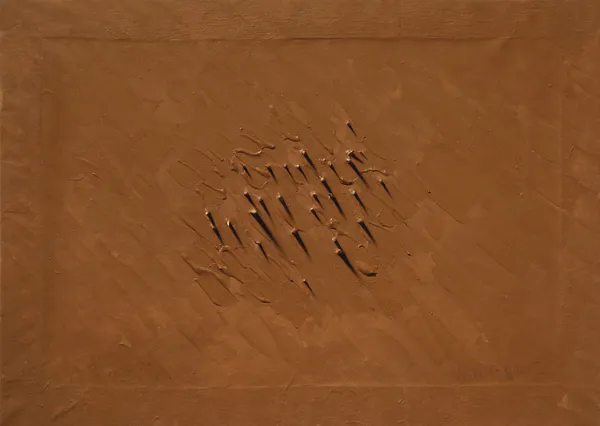
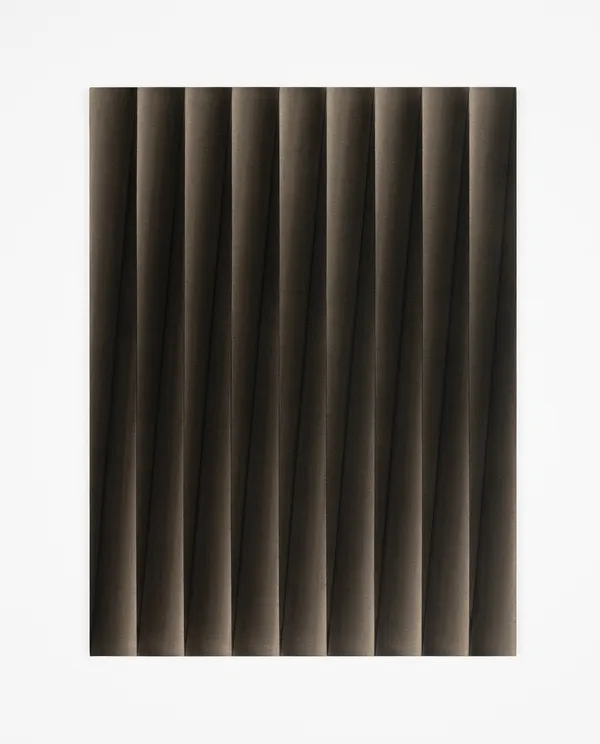
Gallery Baton presents, as our first exhibition of 2026, a group show titled “Against Ornament, Against the Object”, which examines the point of contact between Minimalism and abstraction, as well as the practical derivations that emerge from this intersection. Featuring nine artists, including leading figures from both Eastern and Western contexts : Song Burnsoo, Carl Andre, Robert Mangold, Liam Gillick, and Kazuko Miyamoto, the exhibition considers how works that loosely share minimalist forms can nevertheless embody divergent aesthetic approaches to objecthood, relation, and participation.
As the title “Against Ornament and the Object” suggests, Minimal Art and painterly abstraction, which emerged in the mid-twentieth century, rejected representation grounded in narrative or symbol and tempered subjective expression on the part of the artist. Instead, they concentrated on the question of how viewers, through encounters with artworks, come to recognize their own bodily presence and spatial position. Meaning, therefore, does not resolve into a predetermined narrative but takes shape through each viewer’s process of perception and experience.
Practices that developed in the wake of this trajectory, often described as post-minimal and post-abstract, have retained or varied these formal languages while extending their focus toward the conditions that make viewing possible. Placement, context, and governing rules are rendered visible and treated as integral components of the work itself. Rather than unifying these trajectories under a single interpretive framework, the exhibition allows them to intersect in different ways, creating a space in which the distinct conditions and differences of each work can remain intact and respected.
Across the works of Carl Andre (1935-2024, US), Tapta (1926-1997, PL), and Kazuko Miyamoto (b. 1942, JP), what emerges most clearly is a shared emphasis on open form and material directness. Rather than reducing artworks to instruments of relation or discourse, these artists foreground experiences generated through material and spatial presence itself, revealing how art remains open to the body and to situation. Square zinc plates, an isosceles triangle of neoprene, and nails and string installed on a black wall under strict parameters —through their materials and modes of placement, these works carry an almost light-industrial appearance, while simultaneously minimizing traces of the artist’s subjective hand.
Robert Mangold (b. 1937, US) and Suzanne Song (b. 1974, US) pursue an ongoing inquiry into whether painting can function as a medium capable of holding thought and sensorial narrative. Through color, line, and repetition, they explore geometric pictorial structures that operate according to an internal logic of division and relation. While adopting minimalist forms, their works do not depend on the physical presence of three-dimensional objects; instead, they construct visual structures from within painting itself.
Widely regarded as a pioneer of relational aesthetics, Liam Gillick(b. 1964, UK) strategically appropriates conceptual Minimalism and expands it into a field of institutional critique. His works, characterized by text and forms that recall industrial structures, employ minimalist form as a visual catalyst, activating discourses surrounding institutions, labor, and systems.
Finally, Song Burnsoo (b. 1943, KR), Jimok Choi (b. 1981, KR), and Hiroto Tomonaga (b. 1997, JP) focus on restrained visual articulations of their lived trajectories and on the ways the body responds to external stimuli. The binary compositional structure of center and periphery effectively conveys the states of tension and affect they seek to capture. For these artists, Minimalism is not a concluded historical style but a flexible language that can be reappropriated to allow relation and emotion to permeate the work.
Installation Views
Press release
Works